Showing posts with label Orphanages. Show all posts

Wednesday, February 1, 2012

Changes

And here, we think the winter is a slow and sleepy time, when in actual fact, life is racing along, bring all kinds of twists and turns and changes!

A spurt of cold weather in Odessa (yes, even cold by Canadian standards!) has caused the closure of two of the orphanages in which WHU staff work. At the moment, the orphanages have closed for one week. Our staff are hoping to get back to their regular schedule and time with the kids by next week! Please continue to think of them as they navigate Ukraine's wintry roads.

The foster care pilot has seen a number of changes.Towards the end of December, two more of our girls, sisters, decided to leave their foster home. This time, however, the departure was bitter-sweet. On the one hand, our team and the foster parents were sad to have the girls leave. On the other hand, these sisters will be living as a family with their older sister, who was not apart of the foster care pilot and is currently attending university in Odessa. World Hope Ukraine was glad that they were able to help the sisters obtain the necessary document, so that they are able to receive government financial support, and enroll them in college. The foster parents are keeping in touch and making sure the girls are managing. 

On a lighter note, three more young women were able to enter the pilot and be placed in homes in the last month. Three girls from Hope House, Yana, Tanya and Tanya, were placed in two foster homes. The placement of these girls in foster homes is two fold: one, the girls are living with families, feeling the love, support, and consistency of a family unit, and two, their placement in foster homes has opened up beds in Hope House. Sergiy has already mentioned that orphanages have been contacting him, requesting that they take new girls at the end of this school year! It looks as though Hope House will be full again before too long!

Finally, we can welcome a new set of foster parents to the team, Danik and Sveta! Dina spent long hours preparing them to welcome Yana into their home. 

And so, our project has once again hit some bumps in this road. Nonetheless, onward we go, doing and hoping the best for these girls!

Friday, January 6, 2012

Happy New Year!

Wishing you a very Happy New Year from all the LifeStart Project staff!

2011 has been a very good year overall for Project LifeStart Odessa, full of many accomplishments! Project materials were completed with the help of teams of excellent volunteers, WHU staff were trained, and the project launched! 

Our life skills teachers are now teaching in three orphanages in the Odessa region. Two were late started due to a chicken pox quarantine! Nonetheless, as soon as the quarantine was lifted, our life skills team was there and ready to go!

Kostya and two of our students showing off the collages made by one of the life skills classes

In August four girls were placed in foster homes, with an additional two being placed in November. One of the girls, Alyona, had decided to leave the project after 3 months in a foster home. This was a very difficult and discouraging moment for the foster parents and project staff. However, despite all convincing, Alyona decided she preferred the freedom of life in student dorms. 

On a positive note, however, it was a pleasure to see the remaining girls in foster care really settle into their settings. I personally was blown away to watch one of our girl, Ira, change from a quiet and withdrawn girl to a laughing, smiling one. My theory is that she was waiting and saving herself for a family. It was encouraging to see her settled and happy.

And now, with the project up and running and the onset of 2012, we have just as much work ahead of us as we have behind us! Our focus is turning to project sustainability! We have funding from the Canadian International Development Agency until spring 2013. And so, the fate of the pilots still hangs in the balance. With changes in the Ukrainian government, we must redouble our effort to boast the benefits of the project! Sergiy, WHU Executive Director, will be working hard to contact local government officials and inform them of the project, provide them with materials, tell of the benefits, and show them the girls whose lives are being affected. 

Sergiy talking with Natalya from the Canadian Embassy in Kyiv over lunch at Hope House.


At the same time, Kostya and the life skills team will be traveling far and wide in the Odessa region to work with ready and willing orphanages. They will talk about a life skills program and provide orphanage directors and teachers with the curriculum and training with the hope that the orphanages themselves will be able to teach the curriculum after the funding from CIDA completes.

Kostya heading to the Director's office at an Odessa City orphanage
The point of these activities is to ensure that these opportunities remain available to at-risk youth in Ukraine. These are indirect actions that directly affect the lives of boys and girls in Odessa. 

And so, we have a long road ahead of us!


And, WHU has a new blog where you can keep us with all the latest activities. Here is the link!

Monday, November 7, 2011

A Study

We are currently doing a study comparing girls who have transitioned directly from the orphanages to independent living and girls who have lived in Hope House, a transition home for you women run by World Hope Ukraine and World Hope Canada.


So far, we have gathered information on girls who have left Hope House and transitioned to independent living in the last 3 years. Currently, we are gathering information on young women who went directly from the orphanage to independent living. We are hoping for a sample group of 10-20 girls.


Yulia and Veronika outside their dorm in Odessa

Today, I met with two girls who graduated from their respective orphanages in June and are currently living in a students dorm in Odessa. We conducted a short interview with the girls, asking them about their living conditions, education, income, and personal relationships. I had heard from the girls at Hope House how poor the student dorms were and this interview confirmed this information with facts. 


Both these girls have the status of orphan, which means they draw on a government stipend. However, though  their stipend is supposed to be 2,200 grivnas every month (about $300 a month) on which to subsist, in reality they have only received 1,100 grivnas for two months (about $140 for two months) on which to subsist. The cost of things in Ukraine is similar to prices in Canada. Soviet prices are certainly a thing of the past. 


The girls mentioned they eat no breakfast, have a plain bun and coffee for lunch, and soup or oatmeal for supper. They eat meat maybe once a week and said they never buy fruit because it is too expensive.  One of the girls is suffering from stomach problems from a poor diet. 

Finally, we asked about the dorm. One of the girls said they had one toilet for 40 students and no shower. If she wanted to shower, she went to her friends dorm, where one shower and one toilet was shared with 25 students. They described the kitchen, which had broken ovens and rats.


The girls excited at the options of what they could eat from our Foster Care Coordinator, Dina

Happily, we were able to provide some food and a treat to the girls, but this felt vastly inadequate... 

What this study has told me so far is how many of these students need assistance. Even if we obtain government support and stipends for these girls, life is still difficult. They may not receive the full sum of their stipend. These girls typically have no family to turn to and their orphanages are poorly equipped to provide any help once the girls leave the orphanage.Some are not even provided with enough underwear or bedding to start them off in the dorm. They have nothing and receive little. And worse, they have no one to turn to for help.

We are still hoping the government will support our girls in foster care. This way, these girls would be able to live with a family, have regular meals and stable living conditions. In addition, they would also have adults to care about them and advocate for them. Our pilot is only able to place 6 girls in foster homes. However, we are currently starting a rigorous government relations campaign in order to influence the government to make good on laws they already have. Laws for a foster system exist here, but the government is so far not adhering to them. 

I had thought that once the project was implemented, it would be smooth sailing. As it turns out, we have entered into a vital period and important work lies ahead of us!

Viktoria and Yulia enjoying a meal

Wednesday, September 14, 2011

Another Phase to Project LifeStart Odessa


It has been two months since our teams from Canada worked with teams in Ukraine to get Project LifeStart Odessa up and running. The training weeks have brought a different pace to the project and a new set of activities. 

After months of research, compiling, and writing, we have completed our two reports. One report, At-Risk Youth in Odessa: Opportunities and Challenges, provides a situation analysis of youth in Odessa, whereas another report, Best Practices: At-Risk Youth Report, provides an overview of international best practices in the provision of child welfare services. These reports have been sent off for translation and will soon be available in English on the World Hope Canada website.

During the training, we received wonderful feedback from our teachers. Everyone has high hopes about the coming term! Since leaving, Kostya, the Life Skills Coordinator, and our two life skills teachers, Valya and Alyona, have been working with the orphanages to get everything ready to start teaching with the start of the school term!

The foster care training laid a solid foundation to this aspect of the project. We are currently working on developing ongoing training for the foster parents. This ongoing training will look like a monthly study group and provide more information on topics such as discipline, attachment, and self-esteem. This tool is intended to build on the current foundation and offer further support to our foster parents. We hope to have it ready sometime this autumn.

We have had another interesting development with the onset of an unanticipated trip this autumn to show the project in action to our project worker at the Canadian International Development Agency (CIDA). This trip will happen in October, which is looking like a very busy month for Sergiy. This will be a wonderful opportunity to showcase the project and receive some first hand feedback from CIDA. 

And so, the work continues! 

Wednesday, June 29, 2011

Tough Stuff and Fun Stuff

We met a couple who foster boys from the street here in Odessa. They have participated in our foster care training and will continue to participate in the support group for LifeStart's foster parents. By their organistation, they were provided with a house with enough room for 10 boys. However, problems in their organisation has resulted in them only having 4 boys in their house. They fear that their house will be closed altogether in the next few years. We were able to visit this housу and meet the boys. It was great to see that something was available for boys, but also difficult to see how unsupported they were. Hopefully they will be able to benefit from the support through LifeStart. 

The house: Rick, Maxim,  Sergiy, Ira, Alexei, Igor, Dima, Marina, Anita, and Dina

On a lighter note, we were able to visit an orphanage and do some work there. It was good for the life skills teachers to see the place where they will be working. We also enjoyed a road trip and some fun. 

Here Cathy is having a wild time at the orphanage. 

 Team Foster Care work through some heavy material at the orphanage

Team Life Skills also plowing through the modules and getting acquainted with the space

And here is the whole of team LifeStart, teachers, translators, and even a girl from Hope House (who recently came from the orphanage we were visiting)

And so, the learning and teaching continues. We have only 2 days left of the training week! Here's hopeing we have time enough to get through all the necessary material! :)

Tuesday, October 26, 2010

Orphanages (Иптернаты)

We went to two different orphanages these last two days. It was incredibly interesting to visit them and understand the situation a bit better. We were also able to gather very useful information for our Life Skills Curriculum. We were unsure what facitilities we would be able to use, when we would be able to run the program, how often, who would be able to help, what kind of materials would be available, how many kids, etc. Many of these details were sorted out and, I think, we have a much better idea of where to go from here with the curriculum!

The two orphanages were very different though, each with its own strengths and weaknesses. Sergei, the WHU Executive Director, explained to me that the Director of the orphanage makes all the difference. Luckily, both of these orphanages had Directors who were very keen to work with us and seemed to have the best interests of the kids in mind. 

The orphanage we visited on Monday was about 2 hours outside of Odessa, located just outside a very, very small village. The pro of this orphanage was that is out in the forest, with lots of space for the 114 kids who live there. The Director has worked hard to develop the facility and tapped into as many resources as possible. The kids had up-to-date beds, a nice recreational facility, both indoors and outdoors, and a decent educational facility. The director was full of dreams of what could be done, including developing family-style living on the orphanage complex! The Director also did everything within his power to reduce the dependence on inconsistent resources. They use coal for heating so that they can control the heat. The government will turn off the gas in March or April, when it is still cold and only turn it on in late October, when it is already quite cold. The gas may be turned off any time in between as well. The kitchen is run on electricity, but there is a wood stove in case the electricity is cut. They have their own water tower in case the main water line shuts or has a problem. This is due to inconsistent provision of resources, but also to a crumbling infrastructure. I thought this Director wise to account for the shortages and closures! The con of this orphanage is that because it is located near such a tiny village, with no real economy (I think there was only 2 small stores for groceries and a post office), there is not much for the kids to do once they leave the orphanage. This makes finding a job, starting to live independently and earning an income very difficult! A major problem here is finding jobs. The economy is such that, job are scarce even for those with higher education! Nonetheless, helping prepare the kids to live independently and teaching them how to find jobs through the Life Skills Curriculum will be a step in the right direction!


 A classroom. Everything was neat and tidy. The walls were full of information relating to the subject taught in that classroom. The room seemed to be a good environment for learning with relatively up-to-date desks and chalk boards.

There was even a computer room, which these boys were accessing. This was surprising considering Ukrainians have a relatively low level of computer literacy! 

This orphanage keeps bees, which provides something sweet for the kids, but also, in a good year, is something that can be sold in the local markets for a small profit. 

The Math classroom.  

Classroom for Ukrainian literature and culture. 

Two girls from in the upper years of school. They go to school at the orphanage until grade 9, then go to the local school from grade 9-11. Often the education they receive in the orphanages is sub-par to the local schools (but is still a middle-level education), but here, we were told that the kids from the orphanage are on par with the kids from the community when the join together in grade 10. 

The orphanage is out in the forest, which provide lots of space for the kids. It was a beautiful autumn day when we visited.

The playground. 

And, of course, kids playing in the playground.

The bedrooms here were clean with nice, up-to-date beds. There also seemed to be 4-5 kids per room. 

The bathroom, a nice clean facility.

The kids watching a movie in their play room. It is a holiday for kids in school in Ukraine this week, so the schedule was much more relaxed than usual!

 There was even a health/mini clinic facility here, much to my surprise. Kids were even able to receive some dental care here. 

And a theatre space where kids learn to dance, put on performances, and also watch movies on Saturday evenings.

The floor hallway in the dorms. There was lots of colour and flowers (fake) everywhere for a nice atmosphere.


The second orphanage was also about 2 hours outside of Odessa, though located in a town, much larger than the village of the previous days orphanage. The pro of this orphanage is that the kids interact much more with the local community. Also, because that community is larger, there are more opportunities for the kids once they leave the orphanage. The con of this orphanage is that it has limited space and the facility is quite old (the first orphanage is only 13 years old). There is little room for much more than the dorm-style building and many resources go into simply maintaining the crumbling infrastructure. Moreover, this orphanage, with less space, houses 173 (soon 177) kids. This orphanage seemed to struggle much more with resources. The facility was old and crumbling, the beds were very old, there were often 7 girls jammed into one room with one small wardrobe, no side tables, no desk, and one tiny mirror. Nonetheless, the Director of this orphanage worked hard to get the appropriate status and documents for as many kids as possible. She was also very keen on our program and any measure that might help these kids!

Typical village housing: thatched roofs indicate more extreme poverty. Most people do basic farming, mostly self subsistence in the surrounding area. 


Nadya, one of the Hope House girls, playing on the recreational facilities. She and a few other of the Hope House girls came from this orphanage earlier this summer and Nadya's sister is still here. They came with us to visit and acted as our guides. 

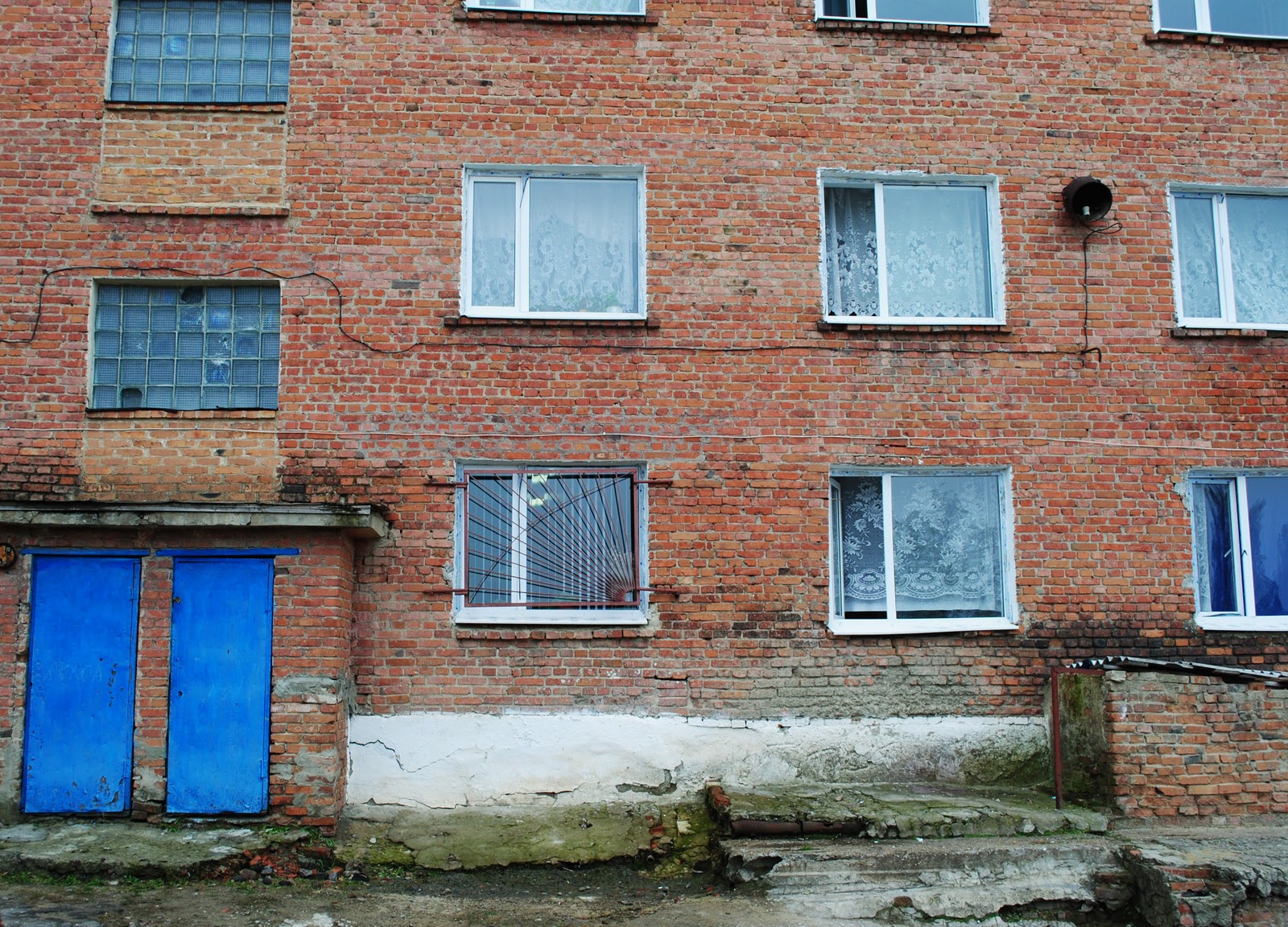
The exterior of the building. It gives a good idea how run down this facility is. 

The kitchen. It was pretty tasty food produced. However, the kids participating will not be able to use this facility. It is registered as an industrial kitchen and only licensed individuals may use it. We were assured that there is a separate facility that we could use to teach the kids cooking. We did not see this facility, however. 

The dining facility. It was clean, but sparce. The kids sit at tables according to their age/class. 

The kids have a recreational room on each floor. Most were just hanging out, watching TV on this drizzly day. We will also be able to use these rooms for the curriculum: perhaps some group work or games.

A room in the dorms where kids could do their homework. A class-room set up with rickety chairs and books dating back to the Soviet Union. We will be using these rooms to teach the curriculum: scare resources, but a willing environment! 


 These are the bed. They are very old and quite rickety. The pillows too, aren't the most comfortable looking. Most rooms did not have side tables and had only one wardrobe for all 7 kids. Resources are scarce, even for some basics!

They add colour wherever they can. Storybook characters decorate the bedroom walls. Each of these flowers has the name of one of the girls who lives in this room. They are doing what they can to spruce up this facility! 

The bathroom: a fairly unpleasant experience, but the facility is old and there is little that can be done to improve this. We will focus part of the curriculum on personal hygiene. 


7 girls in one room and one small desk for all

The kids loved the fancy camera I was toting to snap some shots. They all wanted their photos taken and then  to see the picture. It was an entertaining moment :)

This girl followed up around while we toured the facility. She was very shy, but seemed to want to be in the mix of things


So, it was a very educational day, but also quite difficult. Today I learned about the problem of parental neglect. Ukrainian law does not account for parental neglect. A parent must be proved to be physically or mentally unable to care for their child for parental rights to be revoked. However, if they don't sent their child to school, the government may remove the child and place them in an orphanage to receive education. These kids will not be able to receive government support, though, as they still have living and able parents... on paper, anyway. Parental neglect, in my mind, is a law that needs to be included in Ukrainian child care laws. Today, we brought a little girl and a little boy to the orphanage for this reason. That was difficult, to put it lightly. I can take comfort, though, in that these kids will very likely have a better life in the orphanage, than with their parents. 

Here is the mom sitting with her girl in the orphanage. The girl seemed to adapt quickly and made fast friends. The mom seemed entirely unphased by what was happening.

So, there is a huge difference between orphanages, but the needs of the kids are the same. Very simply, these kids need some love and care in their childhood, and more preparation for life after the orphanage. Though these two orphanages work hard to provide as best they can for the kids, it is still an institution and creates an institutional environment. These kids, despite a good education, have a hard time integrating into the broader society after the orphanage. The goal of our Life Skills Curriculum will better prepare them for life after the orphanage, so that they can find good jobs, maintain themselves and a dwelling, have healthy relationships, and have a strong sense of self. I believe this is achievable and many of the kids seem willing to participate and improve the options and opportunities for their future!